

According to the U.S. Census Bureau, the national business inventories-to-sales ratio dropped from 1.37 to 1.30 over the past year, as of its September 2026 release. Retailers are holding less idle stock relative to sales than they were twelve months ago. That’s not a trend you can ride passively; it’s a sign that tighter inventory control has become the baseline, not a competitive edge.
This guide covers what inventory control actually is, how it differs from inventory management, the components and techniques that make it work, and the specific practices and numbers to track once it’s in place.
Key Takeaways
- Inventory control tracks what you have right now. Inventory management decides what you’ll need next. Confusing the two is why plans and reality drift apart.
- ABC analysis tells you what to prioritize. XYZ analysis tells you how much safety stock that priority item actually needs. Most guides only cover the first one.
- A perpetual system updates the count the instant something moves. A periodic system waits for the next scheduled check. The gap between them is where stockouts and overstocking actually happen.
- Inventory accuracy rate, not turnover alone, is the one number that tells you whether every other number in your reports can be trusted.
Table of Contents
What Is Inventory Control?
Inventory control is the day-to-day work of knowing what’s on your shelves and in your stockroom, right now, not what you ordered, not what you’re planning to sell next quarter. It covers receiving, storing, tracking, and moving stock, the operational layer underneath every larger inventory decision.
Get this layer wrong and everything built on top of it is guessing. A reorder point is only useful if the count it’s based on is accurate. A demand forecast is only as good as the sales history feeding it. Inventory control is what makes those numbers trustworthy in the first place.
Inventory Control vs. Inventory Management
Here’s the distinction most guides blur: inventory control tracks what you have. Inventory management decides what you need.
Control is tactical and immediate: receiving a shipment, counting a shelf, catching a discrepancy before it becomes a stockout. Management is strategic: forecasting demand, choosing suppliers, deciding how much capital to tie up in stock six months from now.
Neither works without the other. A retailer with a great forecasting model and no reliable count of current stock is planning against a number that’s already wrong. A retailer with perfect daily counts but no forecasting strategy will always be reacting instead of planning. Control is the foundation; management is what you build on it.
Why Inventory Control Matters
Overstocking and stockouts are two sides of the same failure
Both come from not knowing, in real time, what you actually have. A stockout turns away a ready buyer. Overstocking ties up cash in something that isn’t moving. Neither is a demand problem first, both are a visibility problem first.
Cash flow depends on it directly
Every dollar sitting in unsold stock is a dollar not available for payroll, marketing, or the next order that would actually sell. Tight control means less capital parked in the wrong place at the wrong time.
Operational efficiency and customer experience both run through the same count
Staff who trust the number on the screen spend less time double-checking shelves. Customers who are told an item is available and then can’t get it lose trust fast, and that’s a control failure, not a bad-luck moment.
Shrinkage hides inside bad control, not despite it
Theft, damage, and administrative error all look identical on paper: inventory that should be there and isn’t. Without a real count you’re comparing against, you can’t even tell how much you’re actually losing, let alone why.
Components and Techniques That Make It Work
Stock tracking: perpetual vs. periodic
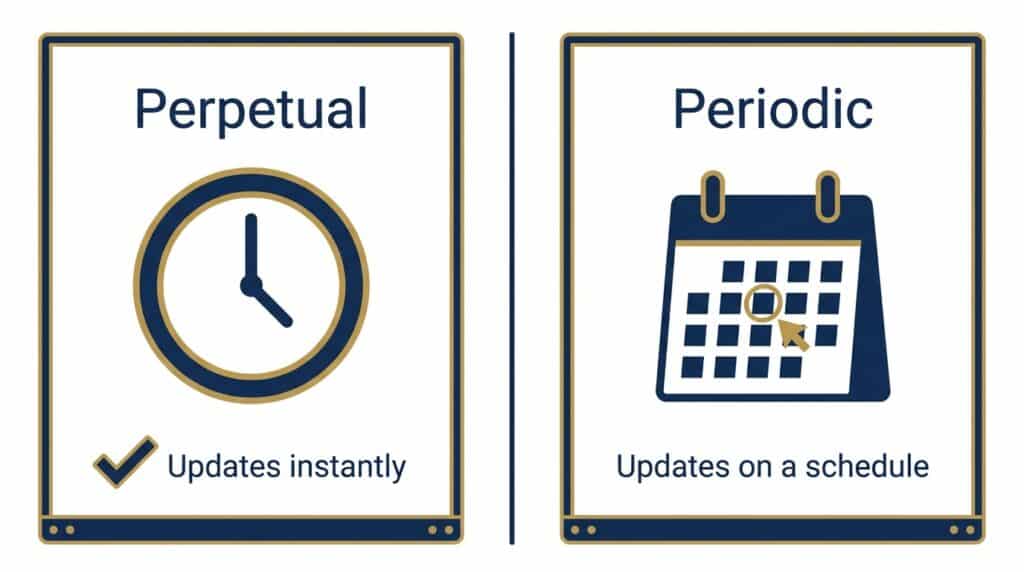
A perpetual inventory system updates your count the instant something happens, a sale, a return, a transfer. A periodic system waits for a scheduled check, weekly, monthly, whenever someone gets around to it. The gap between those two isn’t academic: every hour a periodic system runs behind reality is an hour where your online store, your reorder points, and your staff are all working from a number that’s already stale, and that gap has a real, measurable cost. Barcode and RFID scanning are what make perpetual tracking practical at scale instead of a full-time manual job.
Reorder points
A reorder point is the stock level that triggers a new order. Set once and forgotten, it becomes wrong the moment your sales pattern shifts, which is most of the time. Review reorder points against actual recent sales velocity, not the number that felt right when you set it up.
ABC analysis, paired with XYZ analysis
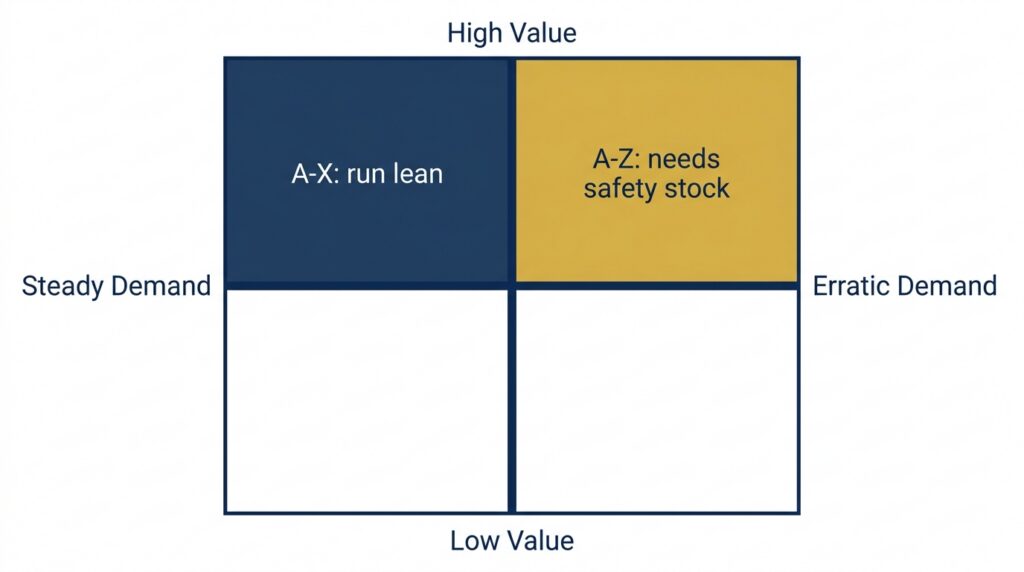
ABC analysis ranks items by value: A-items are your highest-value, highest-priority stock, C-items are low-value and low-priority. That much is standard. What most guides leave out is XYZ analysis, which ranks the same items by how predictable their demand is: X-items sell steadily, Z-items swing unpredictably. Run both together and a different picture emerges. An A-item with steady (X) demand can run lean. An A-item with erratic (Z) demand needs a real safety stock buffer, even though ABC alone would treat both the same.
A boutique treating a steady-selling A-item and an erratic-selling A-item with the same reorder buffer will either tie up cash it didn’t need to, or run out of the one item that actually needed the cushion. XYZ analysis is what tells you which is which before it costs you either way.
Auditing and cycle counting
A full physical count once a year tells you where you stood on one day. Cycle counting, checking a rotating portion of your inventory every week, catches drift while it’s still small. Reserve the full count for what it’s actually good for: a baseline, not your primary accuracy check.
Inventory valuation
How you value stock on the books (FIFO, LIFO, or average cost) affects your reported margins and your tax picture, not just your inventory report. Get the valuation wrong consistently and you’re not just misreporting, you’re heading toward a write-down you could have avoided. This is a decision to make with your accountant, not something to default into.
Best Practices for Effective Inventory Control
Connect your POS and inventory system, don’t run them separately.
The most common mistake independent retailers make is treating point-of-sale and inventory tracking as two systems that happen to share data occasionally, instead of one system where a sale and a stock update are the same event. When they’re separate, someone is always reconciling two numbers that should have just been one.
Review inventory data on a schedule, not when something already went wrong.
Waiting until a customer complains about a stockout is waiting too long. A regular review catches the drift before it becomes a customer-facing problem.
Write down your policies instead of relying on institutional memory.
When the rule for handling a damaged return or a miscount lives only in one employee’s head, it stops working the day that employee is out sick or leaves.
Run cycle counts on a real schedule, not “when there’s time.”
“When there’s time” means never, in practice. Put it on the calendar the same way you’d schedule payroll.
Train staff on the reasoning, not just the steps.
Someone who understands why a count matters catches a discrepancy. Someone who’s just following a checklist skips it the first time they’re busy.
The Numbers Worth Tracking
Inventory accuracy rate is the one metric everything else depends on. It measures how closely your recorded count matches a physical count. If this number is bad, every other report built on top of it, turnover, forecasting, reorder timing, is bad too.
Turnover ratio tells you how fast stock actually moves. We’ve covered how to calculate it and what counts as a healthy range by category in our guide to improving inventory turnover ratio.
Fill rate measures how often you can fulfill an order from stock on hand without a backorder. A low fill rate on your best sellers is usually a reorder-point problem, not a demand problem.
An integrated POS and inventory management system that streams these numbers in real time is what turns this from a monthly reporting exercise into something you can actually act on the same day. RealtimePOS connects automated barcode identification and analytics and reporting into one system, drawing on more than 50 years of combined retail systems experience, so the count on the screen and the count on the shelf are the same number, not two you’re reconciling by hand.
For the specific, day-to-day problems poor control creates, from stockouts to shrinkage to supplier delays, see our key challenges in inventory management guide.
Frequently Asked Questions
What’s the actual difference between inventory control and inventory management?
What’s the difference between ABC analysis and XYZ analysis, and should I use both?
What’s the difference between a perpetual and a periodic inventory system?
See Your Real-Time Count in One Place
Tell us what’s slowing your counts down, and get a straight answer on what fixes it.
No pressure, no obligation, just a straight answer for your setup.