

You’ve got a backroom of stock that falls into two piles: the half that’s water-damaged or expired and will never sell, and the half that’s fine but just won’t move at full price. One of those is a write-off. The other is a write-down. Use the wrong one and you either throw away recoverable dollars or overstate what your inventory is actually worth.
The difference isn’t accounting trivia. It changes the entry you record, how the loss is treated at tax time, and what the loss is quietly telling you about your buying. Here’s the decision, the exact journal entries, and how to stop needing either one so often.
Key Takeaways
- A write-down reduces the value of stock that’s still worth something. A write-off removes stock that’s worth nothing.
- Write-downs come from a GAAP rule: inventory is carried at the lower of cost or net realizable value. When market value drops below what you paid, you mark it down.
- Both cut your assets and hit your income statement. A write-off is just a write-down taken all the way to zero.
- A book write-down for a decline in value usually isn’t tax-deductible until you sell or dispose of the goods. Confirm your situation with your CPA before assuming a deduction.
- Most painful write-offs are avoidable. They come from stock quietly dying while your books still count it at full cost — a visibility problem, not an accounting one.
Table of Contents
- The Short Answer: Write-Down vs. Write-Off in One Look
- What Is an Inventory Write-Down?
- What Is an Inventory Write-Off?
- So Which One Do You Use? The 30-Second Decision
- How Write-Downs and Write-Offs Hit Your Financials
- The Tax Side (Read Before You Assume a Deduction)
- What Each Pattern Is Really Telling You (and How to Need Fewer)
- Frequently Asked Questions
The Short Answer: Write-Down vs. Write-Off in One Look
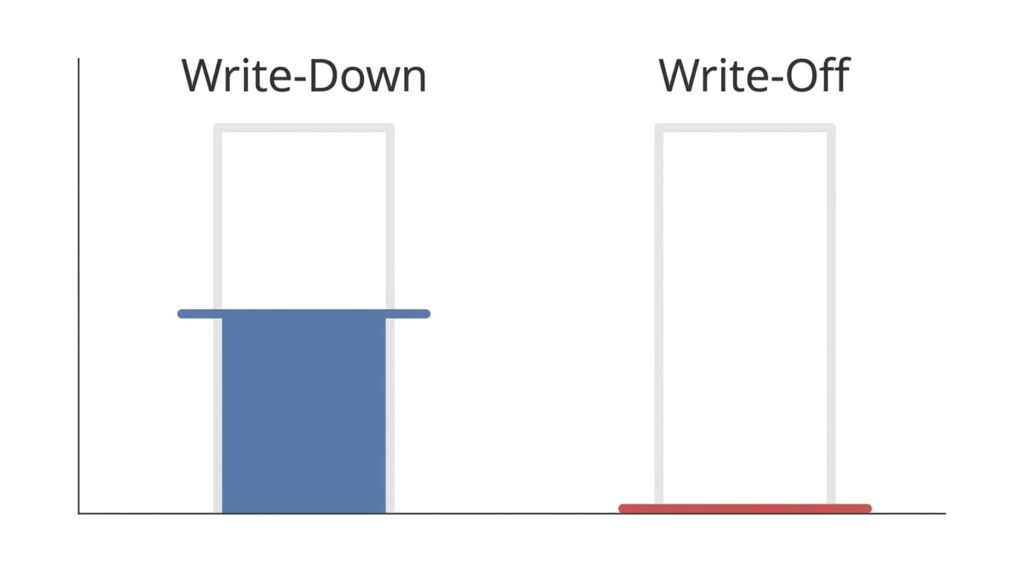
A write-down lowers the recorded value of inventory that has lost some but not all of its worth; the item still sells, just for less than you paid.
A write-off removes the value entirely, because the item is worthless: destroyed, spoiled, stolen, or so obsolete nobody will buy it at any price. The difference is degree a write-off is a write-down taken to zero.
| Write-Down | Write-Off | |
|---|---|---|
| What happened | Value dropped below cost | Value gone entirely |
| Still sellable? | Yes, at a lower price | No |
| Trigger | Market value < cost | Damage, theft, spoilage, obsolescence |
| Book impact | Inventory reduced to new lower value | Inventory removed in full |
| Retail example | Last-season apparel on a 40%-off rack | Expired cosmetics, water-damaged stock |
What Is an Inventory Write-Down?
An inventory write-down happens when the market value of stock falls below what you paid, so you reduce its carrying value to match. This isn’t optional. Under U.S. GAAP, inventory is reported at the lower of cost or net realizable value, the estimated selling price minus what it costs you to sell it. (If you use LIFO or the retail inventory method, the rule is the older lower of cost or market, or LCM, which works on the same principle.)
The moment that number drops under your cost, you’re supposed to mark the inventory down. Carry it at full cost when it’s clearly worth less, and you overstate both your assets and your profit.
When You’d Write One Down
- Last season’s apparel that now moves only on a 40%-off rack.
- A competitor or supplier drops prices, and yours are stuck above the new market.
- Product with minor cosmetic damage that still sells at a discount.
- Perishables approaching their date that you’ll clear at a markdown.
The Journal Entry (With a Real Number)
Say you bought 100 jackets at $40 each, $4,000 on your books. The line stalls and you know it’ll only clear at $22. Your net realizable value is now $2,200, so you write the inventory down by $1,800:
| Dr | Loss on inventory write-down (or COGS) | $1,800 |
| Cr | Inventory (or Allowance for Obsolescence) | $1,800 |
Small, routine write-downs usually run straight through cost of goods sold. Larger or unusual ones get their own line so they don’t quietly inflate COGS and make your everyday margins look worse than they are.
In the retailers we’ve worked with, the cleaner setup is an allowance for obsolescence a reserve account rather than crediting inventory directly, because it keeps the original cost visible for reference instead of erasing your own history.
What Is an Inventory Write-Off?
An inventory write-off removes an item’s value from your books completely, because the item no longer has any. No salvage, no clearance rack it’s gone or unsellable. GAAP expects you to write it off as soon as the value is gone, not to sit on it until a quarter where the hit is more convenient.
When You’d Write One Off
- Stock destroyed by water, fire, or a dropped pallet.
- Food, cosmetics, or pharmacy items past their expiration date.
- Inventory lost to confirmed theft or shrink.
- A serial-tracked appliance or bike that’s become dead stock at any price.
A write-off is usually a discrete, documentable event a spoilage incident, a theft report, a scrapped batch which matters later when you need to prove the loss.
The Journal Entry (With a Real Number)
A cooler failure spoils $1,500 of perishable stock overnight. None of it is sellable, so you remove the full amount:
| Dr | Loss on inventory write-off (or COGS) | $1,500 |
| Cr | Inventory | $1,500 |
The mechanics look almost identical to a write-down. The only difference is the amount a write-off zeroes the item out, a write-down just trims it. One choice to make: the direct write-off method posts the loss straight against inventory as it happens, while the allowance method books an estimated reserve ahead of time and draws against it.
Smaller retailers usually run direct; higher-volume or multi-store operations lean on an allowance so one bad month doesn’t whipsaw the P&L.
So Which One Do You Use? The 30-Second Decision
One question settles it: can this stock still bring in any revenue? If yes, even at a steep clearance or liquidation price it’s a write-down. If no, it’s a write-off.
The mistake worth naming here is scrapping stock that still had value. Writing off a pallet of slow-moving inventory feels decisive, but if a liquidator would’ve paid ten cents on the dollar, you just threw away real money and took a bigger loss than you needed to.
Check for salvage, discount, bundle, or return-to-supplier options before you zero anything out. A write-off should be the last resort, not the reflex.
How Write-Downs and Write-Offs Hit Your Financials
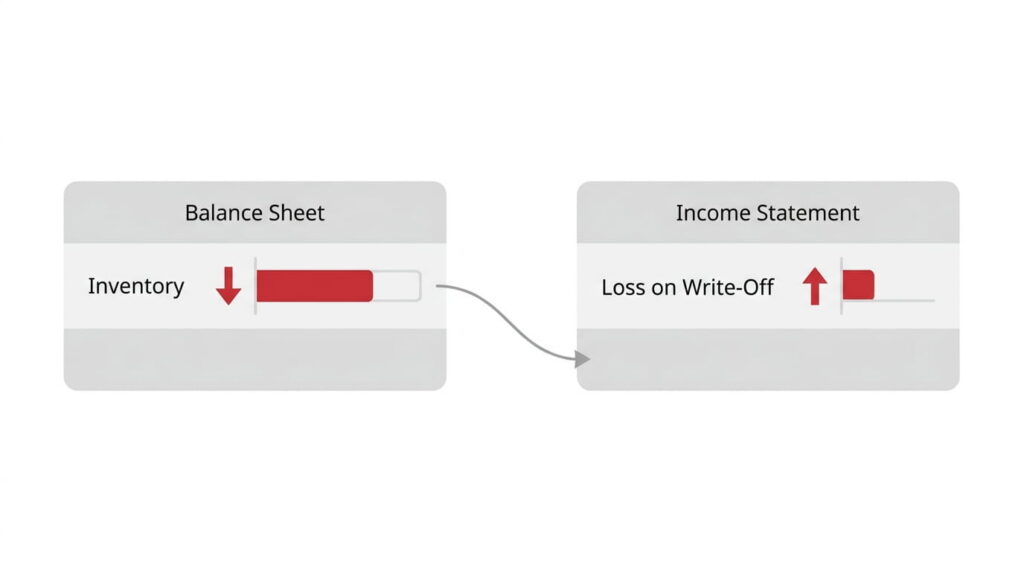
Both reduce inventory on the balance sheet and record an expense or loss on the income statement, which lowers net income for the period. Same direction, different size.
Where retailers get tripped up is what comes after. Fold every loss into COGS with no detail, and your gross margin takes the hit but you can’t tell whether margin slipped because of pricing, theft, spoilage, or bad buying. That’s the common wrong way to do it.
Break material write-downs and write-offs onto their own line, and your operating margin stays honest, and you can finally see which problem is eating your profit.
The Tax Side (Read Before You Assume a Deduction)
Here’s the part that surprises people, and where a lot of blog posts get sloppy: booking a write-down doesn’t automatically hand you a tax deduction.
For U.S. income tax, a write-down that reflects a decline in market value generally isn’t deductible just because you recorded it on your books. In most cases, the deduction shows up when you actually sell or dispose of the goods not when you estimate they’ve lost value.
A general reserve for “stuff that might go obsolete” typically isn’t deductible at all. Write-offs of goods you physically scrap or that are genuinely worthless are usually deductible when disposed of but documentation is everything: dates, quantities, disposal method, photos for damaged stock, incident or police reports for theft.
The specifics depend on your inventory valuation method and your situation, and the rules are genuinely fiddly. This is the one section you shouldn’t wing. Confirm the treatment with your CPA before filing. We build POS systems, not tax returns and no blog post is a substitute for your accountant.
What Each Pattern Is Really Telling You (and How to Need Fewer)
Here’s what the top articles skip. The type of loss you keep taking is a diagnosis.
Frequent write-downs usually mean you’re over-buying or mispricing you keep paying more than the market will bear, then clawing value back at markdown. Frequent write-offs usually mean an operational failure weak rotation, shrink you’re not catching, or storage that damages product. The accounting is the symptom. The buying and the backroom are the disease. Treat a rising write-down line and a rising write-off line as two different problems, because they are.
Across 50-plus years of combined retail systems experience, the write-offs that do the real damage aren’t the dramatic ones. It’s not the flooded backroom. It’s the slow bleed stock that quietly stopped moving months ago, still sitting on the books at full cost, until someone finally counts it and takes the whole hit at once. That’s not an accounting problem. It’s a visibility problem, and it’s fixable.
If you can see what’s aging before it dies, most of it becomes a planned markdown instead of a surprise write-off. This is where real-time inventory tells a different story than a spreadsheet you reconcile at quarter-end. RealtimePOS Inventory Management shows on-hand, on-order, allocated, and in-transit stock as it actually moves data streams straight to a shared cloud database, with no overnight batch job or polling delay hiding a problem for another day.
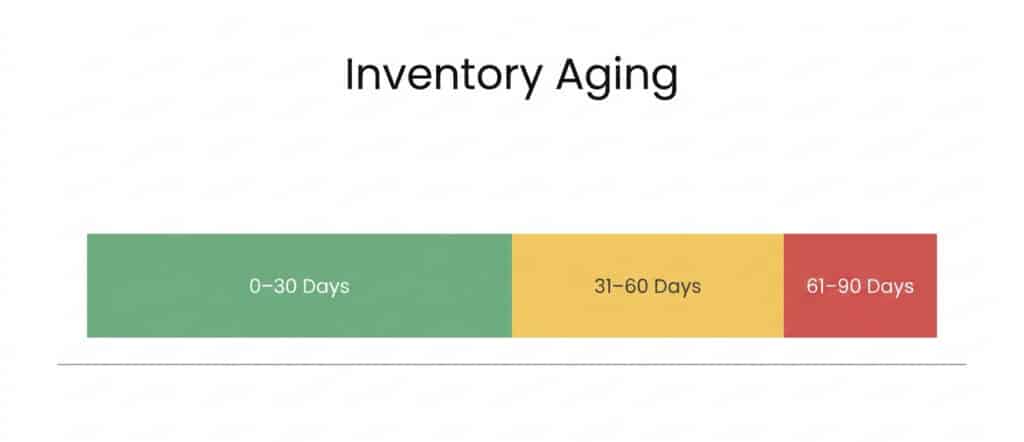
Reporting flags what hasn’t moved in 30, 60, or 90 days, which is the window where a well-timed promotion still recovers most of your cost. Run multiple stores, and Head Office lets you transfer aging stock to the location where it’ll actually sell instead of marking it down in the one place it’s stuck.
You’ll still take write-downs. Every retailer does. You’ll just take far fewer of them by surprise.
Frequently Asked Questions
Is an inventory write-off the same as a write-down?
No. A write-down reduces inventory value partially, because the item still sells at a lower price. A write-off removes the value entirely, because the item is worthless. A write-off is a write-down taken all the way to zero.
Is an inventory write-down tax deductible?
Usually not automatically. A book write-down for a decline in market value generally isn’t deductible until you actually sell or dispose of the goods, and estimated obsolescence reserves usually aren’t deductible at all. Confirm your specific situation with your accountant.
How do you record an inventory write-off journal entry?
Debit a loss or expense account (or cost of goods sold) and credit your inventory account for the full value of the unsellable stock. Keep documentation counts, dates, and the reason for the loss to support it.
When should you write down inventory instead of writing it off?
Whenever it will still sell for something, even at a steep discount. Write it off only when there’s no sellable value left at all: destroyed, expired, stolen, or truly unsellable.
The Bottom Line
Hold onto the rule and the rest follows: worth less, write it down; worthless, write it off. Getting the entry right keeps your books honest. But the bigger win isn’t cleaner accounting it’s needing fewer of these adjustments at all, because you caught the problem while the stock still had value.
If your current system only tells you inventory died after the money’s gone, that’s the gap worth closing. See how RealtimePOS gives you real-time visibility into aging stock, book a demo.