
Updated: October 2, 2026
Hardware stores juggle a product mix almost no other retailer deals with in the same volume, bins of loose fasteners sold by the handful, lumber and pipe cut to custom lengths, paint mixed to order, alongside power tools and seasonal lawn equipment. A $42.8 billion industry built on that complexity needs a POS system that was actually built for it, not a generic retail checkout with a hardware label on top.
Key Takeaways
- Hardware retail’s inventory complexity, bulk items, mixed units, and seasonal swings are the main reason generic POS systems fall short here.
- Contractor and trade accounts, customers who charge purchases and pay on terms, are a real, common hardware-retail workflow that a POS needs to support directly.
- Multi-location hardware chains need centralized visibility, not just per-store reporting, to keep pricing and stock consistent.
Table of Contents
Why Hardware Stores Need POS Software
Hardware retailers manage distinct inventory challenges including tools, building materials, fasteners, and electrical supplies. A dedicated POS system addresses these by enabling real-time stock tracking, bulk and individual item pricing flexibility, barcode scanning, and comprehensive sales and inventory reporting. The right system eliminates manual pricing errors, speeds up checkout during busy contractor-hour rushes, and gives owners a clear view of what’s actually moving.
What Makes Hardware Retail Different
A generic retail POS assumes a simpler world: a fixed number of SKUs, one unit per sale, one type of customer. Hardware retail breaks all three assumptions at once, which is part of why independent hardware retailers are concentrating investment in specific categories rather than spreading it evenly. Paint and sundries, lawn and garden, and hardware and fasteners are where NHPA’s 2026 Market Measure Report shows retailers actually putting their money. A system that can’t track those categories with real precision makes that investment harder to manage, not easier.
Managing Credit and Contractor Accounts
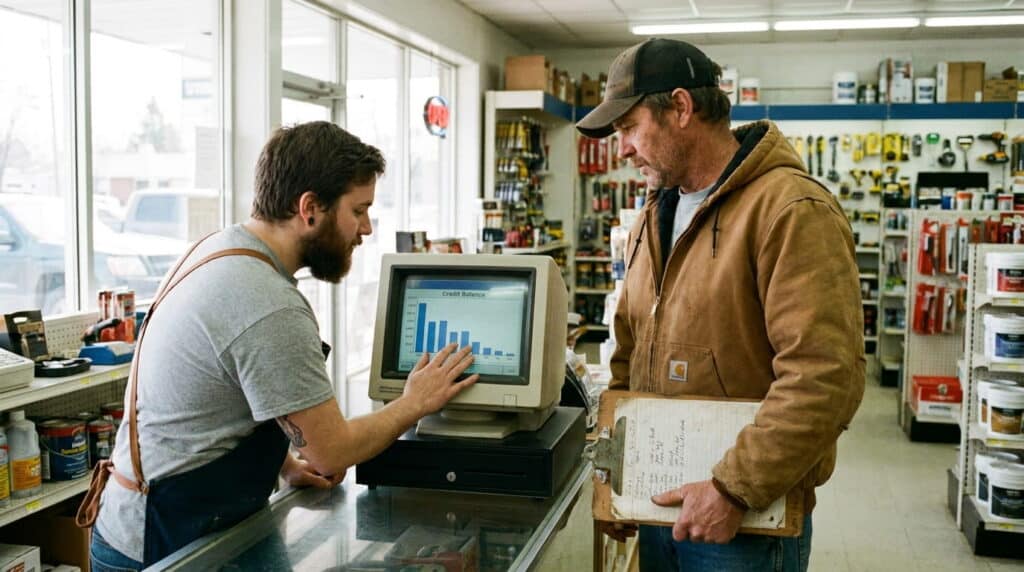
A meaningful share of hardware store revenue comes from contractors and tradespeople who don’t pay at the counter every visit, they charge against an account and settle monthly. That’s a different workflow from a standard retail sale, and it needs to be built into the POS directly, not bolted on. RealtimePOS handles this through AR-approved customer accounts: a business sets a credit limit for an approved customer, that customer charges purchases at the register, and the charges flow into the customer’s ledger for billing, synced with QuickBooks rather than tracked on a separate spreadsheet.
In our experience setting up accounts for hardware retailers, the billing problems that show up later almost always trace back to one thing: an account approved verbally at the counter without a credit limit actually set in the system first.
Multi-Store POS Software for Hardware Chains
Businesses operating multiple locations benefit from centralized management. This allows owners to monitor sales across branches, execute stock transfers between stores, and maintain consistent pricing regardless of how many locations they run. Deciding exactly how inventory flows between stores, and which location fills which order, is its own policy question, covered in more depth in Multi-Location Inventory Sync: Which Store Feeds Carts?
POS Software Built for Hardware Retail
Day-to-day, this means tracking stock levels as shipments come in, barcode scanning for the SKUs that have them, and manual lookup for the ones that don’t, and a point of sale built to handle a hardware store’s actual transaction mix, a contractor buying lumber on account in the same hour as a homeowner paying cash for a box of screws.
Conclusion
Hardware retail doesn’t fit a generic POS template, the inventory is too varied, the customer base splits between walk-in shoppers and standing trade accounts, and the margin for pricing errors is thinner than it looks. A system built around those realities, not retrofitted from a general retail product, is the difference between fighting your software and running your store.
Frequently Asked Questions
What’s the best POS system for a hardware store?
Does a hardware store POS need contractor or trade account support?
Can a hardware store POS handle both bulk and individual item pricing?
Does a hardware store POS need to support multiple locations?
See It Running on a Hardware Store’s Actual Inventory
Bring your real SKU mix, trade accounts, and multi-store setup to the demo, we’ll show you exactly how it handles it.
No pressure, no obligation, just a real walkthrough.