
If you’re still reconciling inventory across channels by hand, spreadsheets, end-of-day counts, a mental note to “check that later”, you already have a sense that it’s costing you something. What you probably don’t have is a number.
That’s the hidden cost of manual inventory tracking: it never shows up as a line item. It’s ten minutes here, a missed update there, a customer service call to smooth over an oversold item, the everyday risk of running multichannel inventory management off spreadsheets. None of it looks like an expense until you add it up, and almost nobody does.
Key Takeaways
- Manual multi-channel inventory costs stay invisible because they’re spread across small, everyday actions instead of one line item.
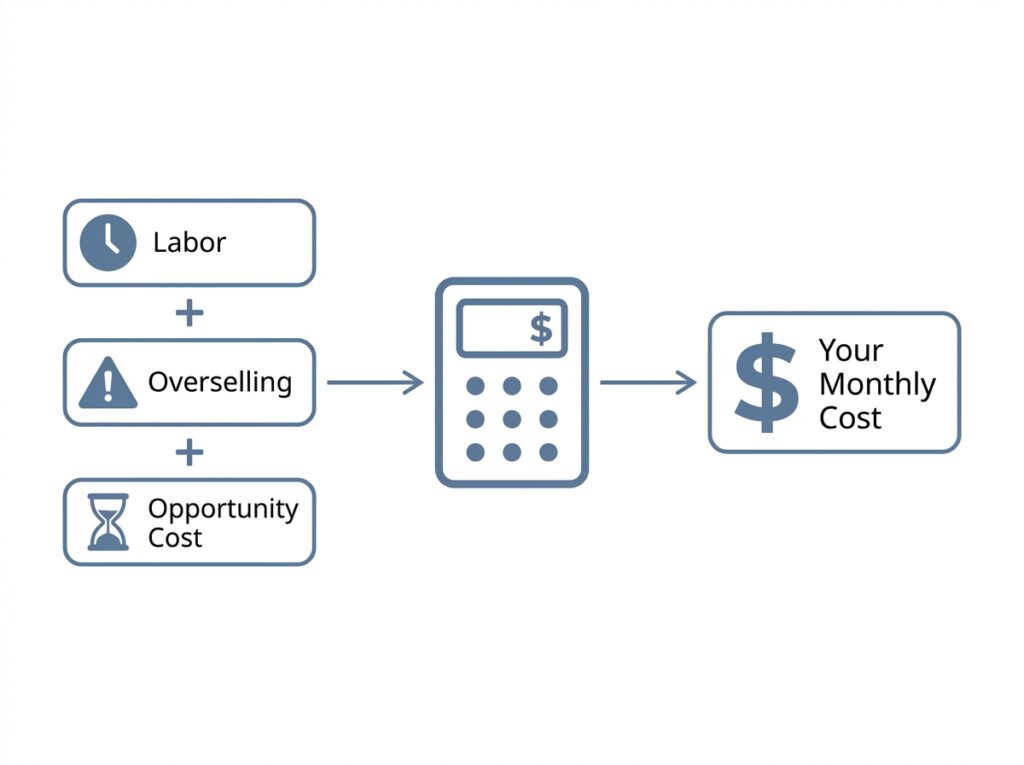
- The real cost breaks into three categories: labor and reconciliation time, overselling and error costs, and opportunity cost.
- You can estimate your own number using a simple framework: channel count times reconciliation hours times wage, plus a rough per-incident overselling cost.
Table of Contents
Why This Cost Stays Invisible
Nobody budgets for “reconciling inventory.” It’s not a bill that arrives monthly, it’s absorbed into everyone’s regular job. A staff member updates stock counts between customers. A manager double-checks numbers at close. None of it gets logged as a cost, so none of it gets questioned.
In the stores we work with, this is the pattern that shows up over and over: the business isn’t unaware that something’s inefficient, it just has no number attached to it. Without a number, there’s nothing to compare against the cost of fixing it, so the manual process just continues by default, not because anyone decided it was the right call. This is one of the most common challenges we see across independent and multi-store retailers alike, and it’s worth reading further into the key challenges in inventory management that retailers run into once they start looking closely.
The Real Cost Categories

Labor & Reconciliation Time
Start with the most direct cost: staff hours. If someone spends even 30 minutes a day reconciling stock counts across two or three channels, that’s roughly 10 hours a month, before accounting for the time lost catching and fixing mistakes found during that reconciliation. At $18/hour, that’s about $180 a month in labor alone, for one employee doing this part-time. Add a second channel or a busier season, and that number climbs fast.
In our installs, the most common mistake we see isn’t that a store has no process, it’s that the process depends entirely on one person remembering to run it consistently. When that person is out sick or swamped, the reconciliation slips, and the gap between what the system says and what’s actually on the shelf grows until someone notices the hard way, usually a customer.
Overselling & Error Costs
An oversold item costs more than the refund. There’s the lost sale itself, the time a staff member spends handling the customer complaint, and often a discount or gesture offered to keep the customer from leaving a bad review. None of that shows up as “inventory cost” on a P&L, it gets buried in customer service time and discounting.
Industry research on “inventory distortion,” the combined cost of stockouts and overstock, puts the number in the trillions of dollars globally each year, a macro figure that doesn’t help size your own store’s cost, which is exactly why the framework below matters more than the headline number. Closing that gap starts with real-time inventory sync, so every channel reflects the same count the moment something sells.
Opportunity Cost
This is the category that’s easiest to miss entirely. Every hour spent manually reconciling stock is an hour not spent on merchandising, staff scheduling, or actually talking to customers on the floor. For a small team, that trade-off is real: the person doing inventory admin isn’t doing the parts of the job that actually grow the business.
Estimate Your Own Cost
Here’s the framework we walk retailers through when they ask us to put a real number on this, instead of a vague sense that “it’s probably costing us something.”
| Cost Category | What to Multiply | Example |
|---|---|---|
| Labor & reconciliation | Hours per week x hourly wage x 4.3 weeks | 2 hrs/week x $18/hr x 4.3 = ~$155/month |
| Overselling incidents | Incidents per month x (lost sale + handling time value) | 3 incidents x $40 average = ~$120/month |
| Opportunity cost | Hours redirected from higher-value work x wage | 2 hrs/week x $18/hr x 4.3 = ~$155/month |
Add those together, and a modest two-channel operation can be looking at $400-plus a month, before accounting for a bad month where a bigger error slips through. Plug in your own hours, your own wage, and your own rough incident count, the framework holds regardless of the numbers.
When Manual Costs More Than Automating
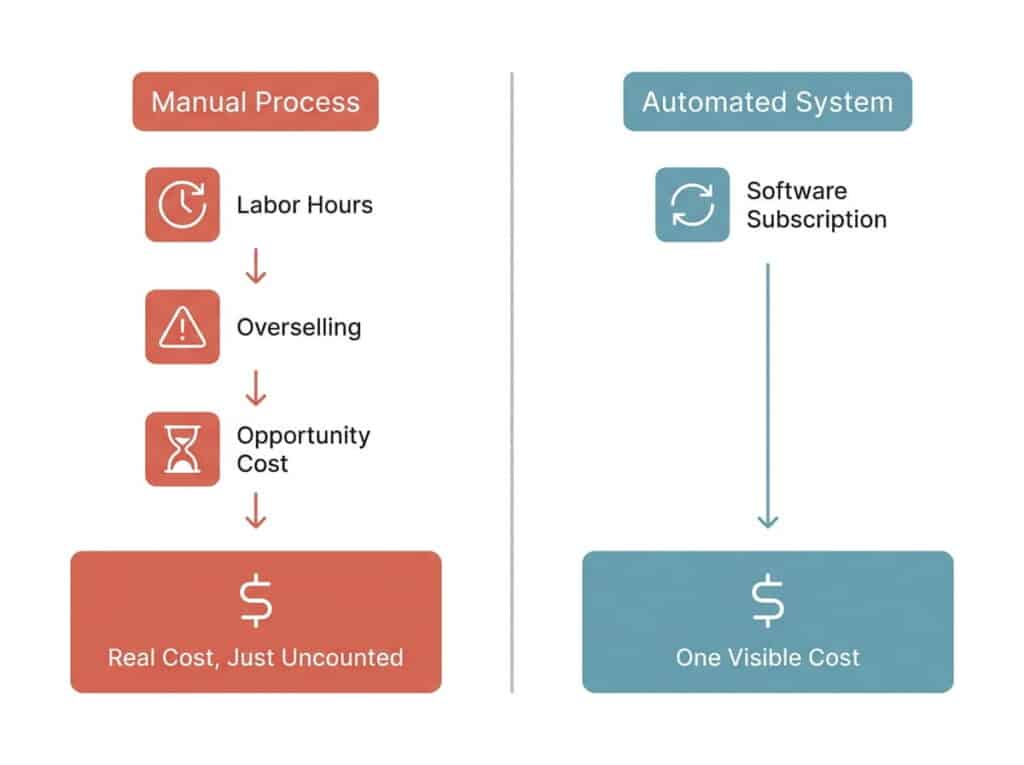
Once you have your own number, the comparison gets a lot more honest. Inventory management software costs vary widely depending on what you need, but it’s common for the manual cost calculated above to already exceed what a real solution would run monthly, especially once you count the labor hours you’d get back.
The instinct to see automation as “the expensive option” usually comes from comparing a software price tag against zero, treating the manual process as if it’s free. It isn’t. It’s just costed in staff time instead of an invoice. Once your own number is on paper, you’re not choosing between free and paid, you’re choosing between two real costs.
See how connecting your inventory across every sales channel closes this gap directly.
If you’re running more than one storefront or marketplace, see how real-time sync across every cart actually works before you commit to a fix.
Frequently Asked Questions
How much time does manual inventory reconciliation actually take per week?
What does one overselling incident really cost, beyond the refund?
How do I estimate my own store’s cost of manual inventory tracking?
At what point does manual inventory management cost more than software?
See What Automated Sync Actually Saves You
Get a real number for what manual multi-channel inventory is costing you, then see how Realtime POS closes that gap.
No pressure, no obligation, just a real number for your setup.