
You want to sell on eBay, and you’re worried the same item will sell twice, once in your store, once on an active eBay auction, before either system knows about the other. That worry is legitimate: eBay’s listing structure isn’t like a standard online store, and pretending it syncs the same way is how retailers end up owing two customers one unit.
This isn’t a connect your account and you’re done guide. It’s an honest look at where your POS’s job ends and where eBay’s own quirks, especially auction-style listings, require different handling.
Key Takeaways
- Most POS systems can’t talk to eBay Seller Hub natively; a sync layer usually has to sit between them.
- Auction-style listings sync differently than fixed-price listings, and treating them the same is how overselling happens.
- Launch with a limited catalog and a stock buffer for the first few weeks, not your full inventory on day one.
- eBay’s scale, tens of billions in GMV annually, means sync discipline matters here as much as on any other channel.
In This Guide
What Your POS Can (and Can’t) Do for eBay Out of the Box
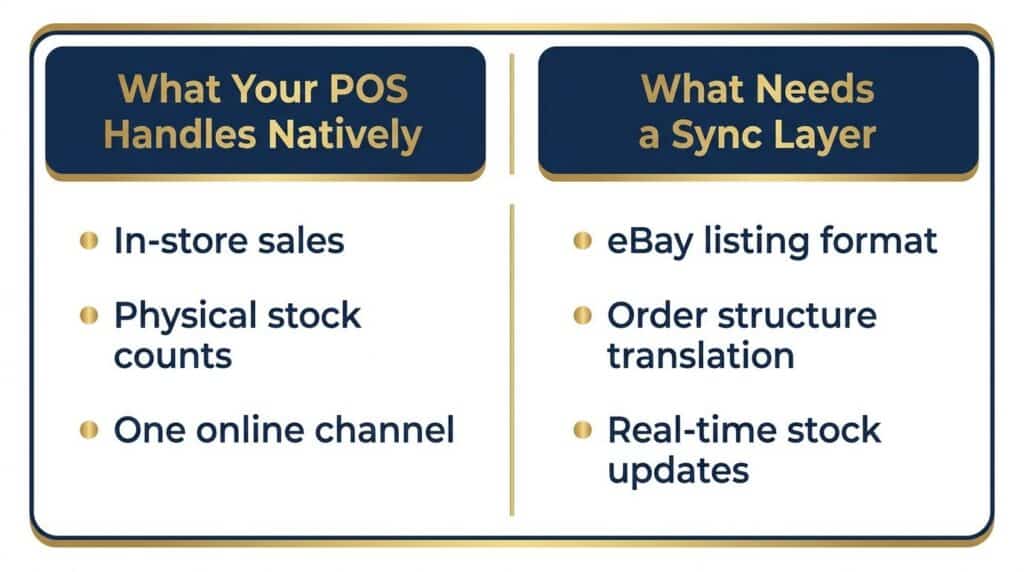
Your POS was built to run your register and track your stockroom, maybe a website too. It wasn’t built to understand eBay’s specific listing formats, its order structure, or the difference between an auction that’s still live and one that’s already closed.
In our installs, retailers who get caught off guard aren’t the ones with a weak POS, they’re the ones who assumed integration meant one setting. What actually happens: your POS keeps doing what it’s always done, tracking physical stock and your existing channels, while a separate sync layer translates that into something eBay’s system understands and reports back changes from eBay’s side. Skip that layer, and you’re manually checking two systems again, the exact problem you were trying to avoid.
A point of sale system built with ecommerce integration already accounted for is what makes adding eBay a sync-layer decision instead of a system overhaul.
Fixed-Price vs. Auction Listings: Why Sync Works Differently
Here’s the part that separates eBay from every other channel you might sync: not all listings behave the same way.
A fixed-price listing works like inventory on any other channel, quantity goes down as units sell, and your sync layer updates that count across every connected system. An auction-style listing is different: once someone bids, that unit is effectively spoken for until the auction closes, even though no sale has technically happened yet. If your sync layer treats that unit as still available everywhere else, you can sell it in-store while the auction is still running, and now you owe two people the same product.
| Fixed-Price Listings | Auction-Style Listings | |
|---|---|---|
| When inventory updates | Immediately on sale | Effectively reserved once bidding starts |
| Sync risk | Low, standard sync handles it | High if sync doesn’t account for active bids |
| Recommended handling | Standard real-time sync | Hold the unit as reserved for the auction’s duration |
How to Handle Sync for Active Auctions
The safest approach: the moment an auction-style listing goes live, mark that unit as reserved in your inventory system, not just in stock. Don’t wait for the sale to complete before pulling it out of your sellable count elsewhere. If the auction ends without a winning bid, release the reservation and the unit goes back into your available pool.
How to Connect Your POS to eBay Seller Hub, Step by Step
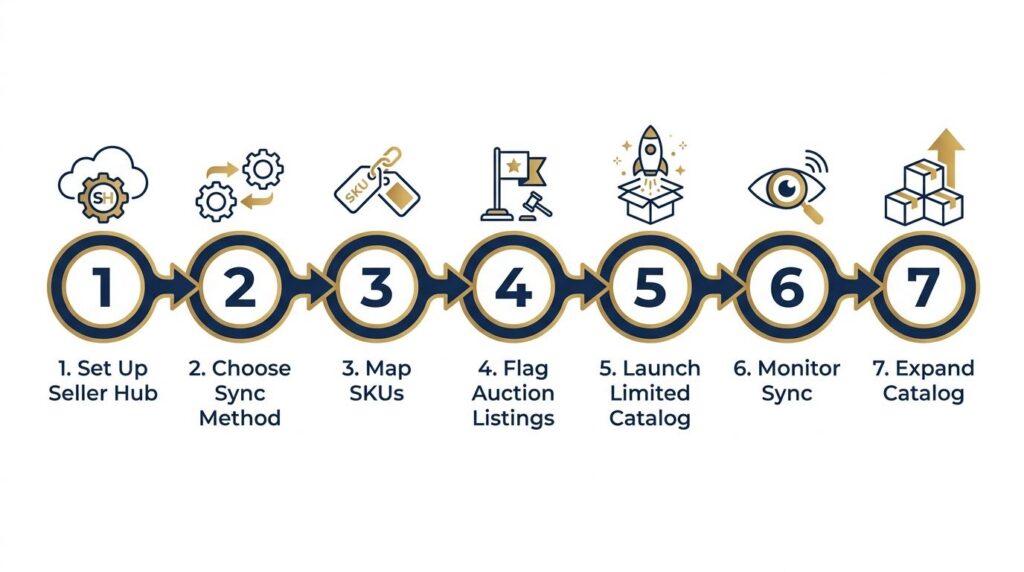
Here’s the order that actually works:
- Set up your eBay Seller Hub account and confirm your seller settings.
- Choose a sync method between your POS and eBay, either a native integration if your POS supports one, or a middleware connector if it doesn’t.
- Map your SKUs so eBay’s listings match your existing inventory records exactly.
- Flag any auction-style listings for reserved-stock handling, not standard sync treatment.
- Launch with a limited catalog and confirm sync accuracy before adding more products.
- Monitor stock updates for the first several days to confirm eBay reflects sales from your other channels quickly.
- Expand to your full catalog once sync has proven reliable.
If you’re also selling on Amazon, our guide to Amazon marketplace integration covers that connection specifically, worth a look if you’re running both channels.
Avoiding Overselling Across eBay and Your Other Channels
A cancelled eBay order because of a sync gap doesn’t just cost you that sale, it hurts your seller performance metrics, which affects how your listings get shown going forward.
In the accounts we’ve worked with, the retailers who avoid this launch small on purpose. Pick 15 to 20 of your best-selling SKUs, hold back a small buffer, maybe 2 to 3 units per item, and watch how quickly your sync reflects a sale made anywhere else before adding your full catalog. If a sale in-store takes hours to show up on eBay, that gap is exactly where a double-sale happens.

Our guide to real-time inventory sync covers this exact failure mode in more depth.
eBay’s Marketplace Scale, in Context
This isn’t a small side channel. eBay reported $79.6 billion in Gross Merchandise Volume for full year 2025, according to eBay’s own investor relations disclosures, up 7% year-over-year.
That’s the context worth keeping in mind: eBay isn’t a lower-stakes channel just because it’s been around longer than Amazon or Shopify. The sync discipline that matters everywhere else matters here too.

Frequently Asked Questions
How do I connect my POS system to eBay Seller Hub?
Set up your eBay Seller Hub account, choose a sync method, native integration or middleware, map your SKUs to match your existing inventory records, and flag any auction-style listings for special handling before going live.
Does eBay inventory sync automatically with my POS?
Not by default. Most POS systems need a separate sync layer or middleware connection to translate inventory data between your system and eBay’s listing structure.
Do auction-style eBay listings sync inventory differently than fixed-price listings?
Yes. A fixed-price listing updates like standard inventory when it sells. An auction-style listing should be marked as reserved the moment bidding starts, not just when the auction closes, or you risk selling the same unit elsewhere while the auction is still live.
Can I sell on eBay without a separate inventory system?
Technically yes, by updating eBay manually, but that breaks down quickly once you’re selling the same products across more than one channel. A sync layer between your POS and eBay is what actually prevents overselling.
Ready to Add eBay Without Breaking Your Inventory?
See how Realtime POS syncs your inventory in real time across every channel, including eBay, before you flip the switch on a new one.
Book a Free Demo View Pricing