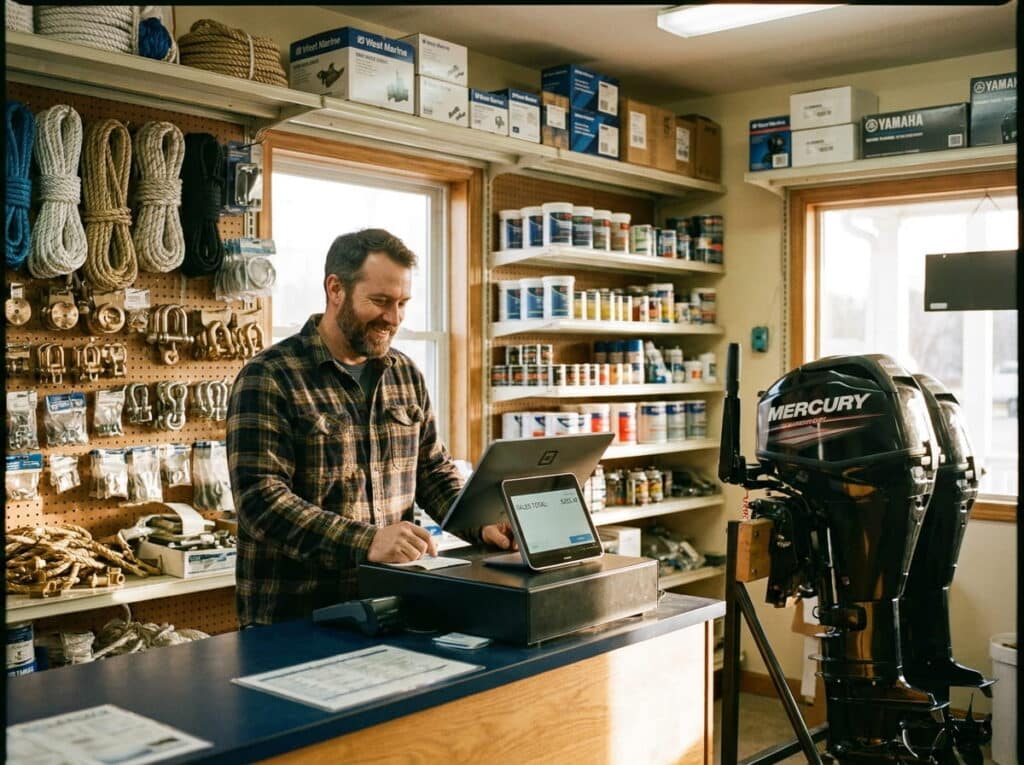
If you’re running a marine supply store on a generic POS system, you already know something’s off. Maybe you’re double-checking special orders on a sticky note. Maybe nobody trusts the inventory count anymore. The real question isn’t whether something’s wrong, it’s whether your system is the actual problem, or just an easy thing to blame.
Here’s the short answer: “outgrowing” a POS system rarely means your store got bigger. Usually it means your inventory got more complicated than the system was ever built to handle, and a marine supply store’s inventory gets complicated fast.
Key Takeaways
- Outgrowing a POS system is usually about inventory complexity, not store size or revenue.
- Serialized items, special orders, and seasonal demand swings are the three most common breaking points for marine retailers.
- You don’t need a full boat-dealership management system to fix this. A retail POS built for serialized and special-order inventory closes the gap without the added cost and complexity of a dealership platform.
Table of Contents
What “Outgrowing” Actually Means for a Marine Store
Most articles about outgrowing a POS system point to growth: more locations, more staff, more transactions. That’s true for a lot of retailers. It’s rarely the real trigger for a marine supply store.
What actually breaks a generic system is the shape of the inventory, not the size of the business. Marine supply store inventory management has requirements a generic system was never built for: a single-location shop selling outboard motors and rigging hardware can hit the ceiling faster than a five-location apparel chain, because motors need serial tracking, hardware needs marine-specific classification, and half your counter sales are special orders tied to a specific customer’s boat.
None of that shows up in a typical retail SKU field. In the stores we work with, this is the pattern that shows up over and over: the system isn’t slow or buggy, it’s just answering a simpler question than the one the business actually has.
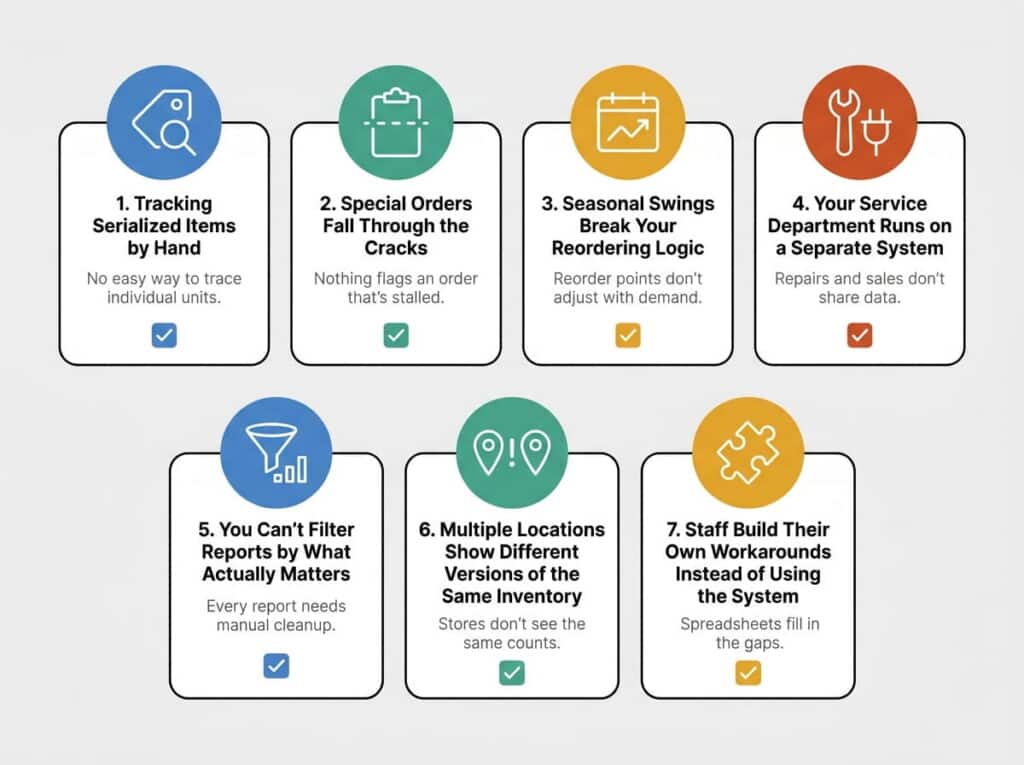
7 Signs Your Marine Store Has Outgrown Generic POS
1. You’re Tracking Serialized Items by Hand
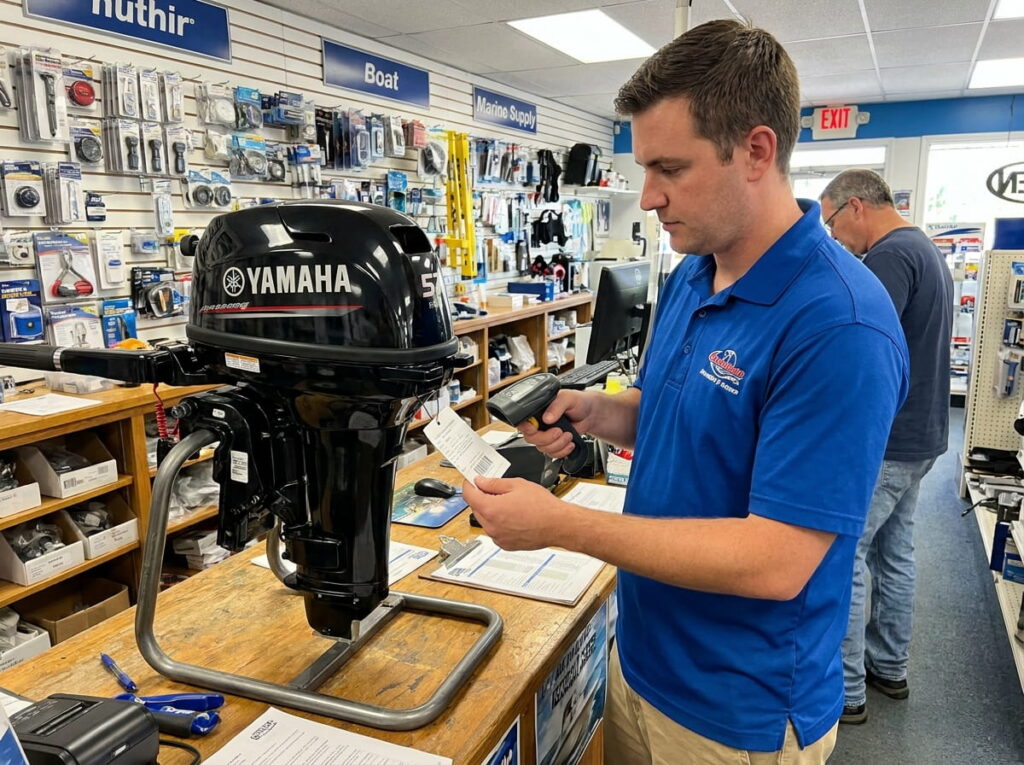
If you sell outboard motors, trolling motors, or other high-ticket serialized gear, each one needs its own identifier tracked from receiving through sale, not just a quantity count. A generic POS treats a motor the same way it treats a coil of rope: one SKU, one price, quantity on hand. When that motor’s serial number lives in a separate spreadsheet or a notebook by the register, you’ve already left the system’s actual job to a human, and humans miss entries.
The most common failure we see isn’t a lost sale, it’s a warranty claim or a reconciliation problem months later, when nobody can confirm which unit actually shipped, especially without inventory that syncs in real time across every sale.
2. Special Orders Fall Through the Cracks
A generic system assumes a sale is in-stock and done the moment it’s rung up. Marine retail doesn’t work that way. A customer orders a part for a boat you don’t stock, it’s backordered for three weeks, and somebody has to remember to call them when it lands. Without a real special-order workflow, that tracking lives in someone’s head or a paper ticket taped to a shelf. It works fine until that person is out sick the day the part arrives.
3. Seasonal Swings Break Your Reordering Logic
Marine demand isn’t flat. Spring brings a rush on parts and accessories; winter slows to a crawl in most regions. A generic POS with static reorder points doesn’t know the difference, so you either overstock heading into the off-season or run out right as the season opens, which is the worst possible time to be out of stock.
4. Your Service Department Runs on a Separate System
If repair and service work is tracked in a different tool than counter sales, parts pulled for a repair job aren’t syncing back to your retail inventory count. That gap compounds fast: your counter shows stock that’s actually sitting in a technician’s bay, already committed to a job. The fix is work orders that sync back to retail inventory the moment they’re created, not a separate system running on its own schedule.
5. You Can’t Filter Reports by What Actually Matters
Ask a generic POS to show you sales on marine hardware specifically, separate from general merchandise, and most can’t answer cleanly. Purchasing decisions end up being made on a blended number that doesn’t reflect what’s actually moving in your core category.
6. Multiple Locations Show Different Versions of the Same Inventory
(Skip this one if you’re single-location, it’s not your problem yet.)
Add a second location or a marina counter, and a generic system often can’t give you one accurate, shared inventory picture across both. Each site ends up running its own version of the truth. In our experience, this is the single most common reason multi-location marine retailers start evaluating a new system, not revenue growth, but the moment a second site makes “what do we actually have in stock” impossible to answer with confidence.
7. Staff Build Their Own Workarounds Instead of Using the System
This is the tell. Sticky notes for special orders. A side spreadsheet for serial numbers. “We just remember” as an actual inventory strategy. If your team has quietly built a shadow system around the POS instead of through it, that’s not a training problem. That’s the system telling you it can’t do the job.
Generic POS vs. Marine Dealership DMS: What’s Actually Different
Here’s where most marine retailers get stuck. Once you start researching alternatives, nearly everything marine-specific that comes up is a full dealership management system, built for boat sales, financing, and service departments. That’s a different business than running a parts and accessories counter, and it’s a lot more of a system than most supply stores need.
| Generic Retail POS | Marine Dealership DMS | Marine-Aware Retail POS | |
|---|---|---|---|
| Scope | General retail, any vertical | Boat sales, financing, service, parts | Parts, accessories, service, no boat sales/financing |
| Cost | Low | High, built for dealership-scale operations | Mid, retail pricing |
| Complexity | Simple, but no serialized/special-order support | High, built for a different business model | Matched to a parts/supply retailer’s actual workflow |
If you’re not selling boats and financing deals, a full DMS is solving problems you don’t have while charging for them anyway.
What to Look For Instead
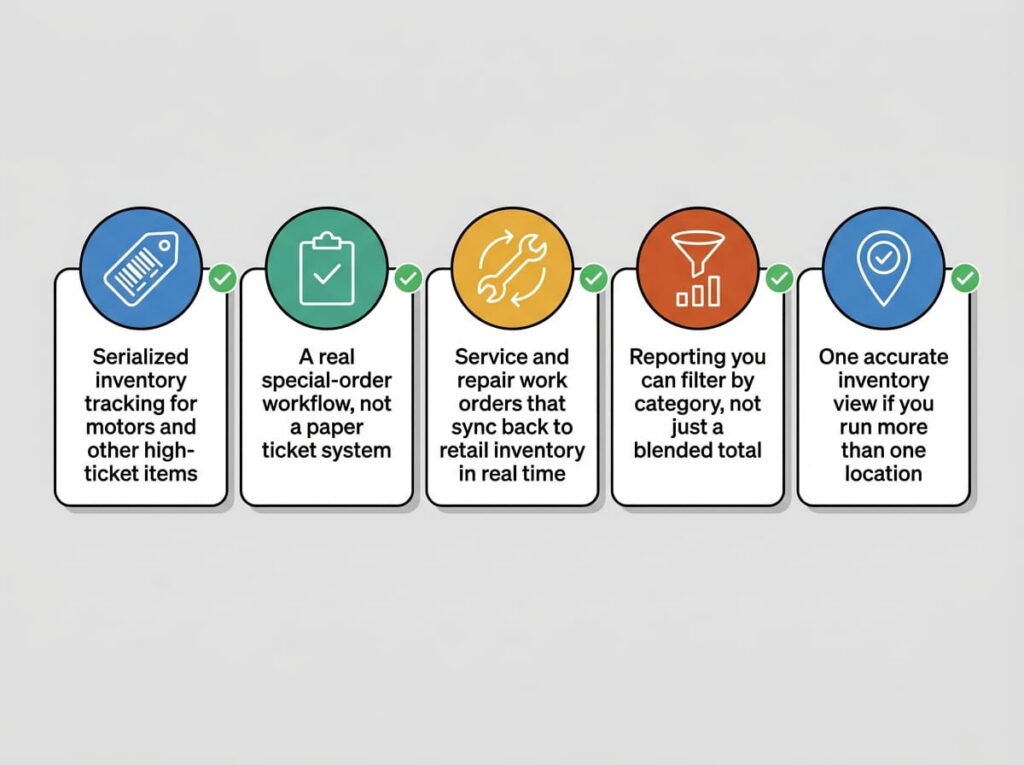
You don’t need a dealership platform. You need retail POS that was actually built to handle marine-specific inventory. At minimum, that means:
- Serialized inventory tracking for motors and other high-ticket items
- A real special-order workflow, not a paper ticket system
- Service and repair work orders that sync back to retail inventory in real time
- Reporting you can filter by category, not just a blended total
- One accurate inventory view if you run more than one location
See what a marine supply store POS built for this actually looks like.
Frequently Asked Questions
How is a marine supply store POS different from a boat dealership DMS?
What’s the difference between IMPA coding and a standard SKU system?
Do I need a full dealership management system, or just better retail POS?
How do I track serialized parts like motors without a full DMS?
Ready to See What Marine-Aware POS Looks Like?
See how Realtime POS handles serialized inventory, special orders, and service work orders, built for parts and accessories retailers, not boat dealerships.
No pressure, no obligation, just a real look at what fits your store.